
Mold remediation doesn’t fail because someone didn’t spray enough product.
It fails because process wasn’t followed.
Assuming the moisture source has been identified and corrected — and damaged materials are being removed — there are four foundational protocols that determine whether remediation is successful.
These are not optional. They are structural.
1. Containment: Stop the Spread Before You Start
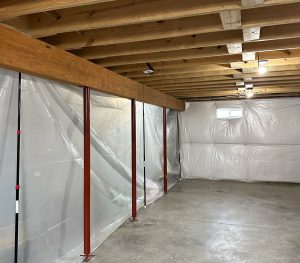
Containment prevents cross-contamination. Without proper containment, demolition and cleaning activities can distribute contamination into previously unaffected areas of the home.
Proper containment includes:
- Sealed work zones
- Critical barriers
- Controlled entry points
- Negative air where appropriate
Containment is one of the most cost-effective safeguards in a remediation project — and one of the most overlooked. If it isn’t contained, it isn’t controlled.
2. Air Scrubbing: Control the Air While Work Is Happening
Air scrubbing within containment is not cosmetic. It reduces airborne particulate load and helps maintain negative pressure, preventing contaminants from escaping into adjacent spaces.
This typically includes:
- HEPA-filtered air scrubbers
- Continuous operation during active work
- Exhausting air appropriately when required
Air is a transport mechanism. Control the air, and you control spread.
3. Abrasion: Remove, Don’t Mask
This is where many projects cut corners.
Mold does not resolve because it was sprayed. It resolves because it was physically removed.
Abrasion methods — whether sanding with HEPA attachment, soda blasting, dry ice blasting, or planing — serve one purpose: To remove contamination at the material surface.
This step is labor-intensive. It requires time. It requires care.
But without physical removal, debris and embedded growth remain. And “treated” is not the same as “clean.”
4. Detailed Surface Cleaning: The Reset
After removal and abrasion, surfaces must be cleaned thoroughly within the containment area.
This includes:
- Industrial HEPA vacuuming
- Wipe-down of structural surfaces
- Cleaning of settled debris
The scope of this step depends on the level of contamination and the health sensitivity of the occupants. But skipping detailed cleaning is one of the most common reasons homes “pass” testing yet still feel reactive.
The Bottom Line
You can ask ten professionals and receive ten variations in method. But the principles remain steady:
Contain.
Control the air.
Physically remove contamination.
Clean meticulously.
The right remediation plan balances effectiveness, feasibility, and cost — but it never compromises on process.
At NEST, our role is not to sell fear. It’s to bring clarity to a space that often feels confusing.
Because remediation done correctly isn’t about doing more. It’s about doing the right things, in the right order. And when that happens, forward movement becomes possible.