
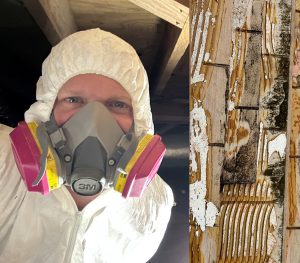
Successful remediation isn’t about the product someone sprays. It’s about process.
And understanding the difference can prevent one of the most common and costly mistakes families make: thinking the job is done when it isn’t.
Here’s what we want every homeowner to know before remediation begins.
1. There Is No “Magic Bullet”
Fogging. Botanicals. UV HVAC add-ons. Ozone. Air purifiers.
Many of these tools have a place — but none of them replace proper remediation.
If water-damaged materials remain, contamination remains.
If containment isn’t established, cross-contamination spreads.
If surfaces aren’t physically cleaned using HEPA and abrasion, particles stay behind.
Remediation requires:
- Removal of water-damaged building materials
- Proper containment and negative air with HEPA filtration
- Adequate air changes
- Detailed cleaning of surfaces and contents
- Addressing contaminated belongings
Sprays and fogging alone do not create a safe indoor environment. They are supplemental at best — never substitutes for structural correction.
If chemical sensitivity is a concern, request Safety Data Sheets (SDS) for any product being used. Know what’s entering your home before it enters your home.
2. Set Expectations — In Writing
In most states, mold remediation is not heavily regulated. That means you must understand:
- What procedures will be used
- Why those procedures matter
- What defines a “successful” outcome
- What happens if verification fails
Post-remediation verification (PRV) should never occur on the same day — or even the next day — after work is completed.
Airflow and dust levels must return to normal equilibrium before testing.
Clear documentation protects everyone involved — especially your family.
3. Fix the Source — Or It Will Return
No remediation is successful if the water source is not identified and corrected.
Roof leaks. Foundation moisture. HVAC condensation. Plumbing failures. Vapor intrusion.
If moisture continues, mold returns.
The question isn’t whether remediation was “strong enough.” The question is whether the root cause was resolved.
4. Choose Professionals Who Understand Health
If your family is navigating CIRS, chemical sensitivity, or complex health reactions, your remediation team should understand:
- Cross-contamination dynamics
- Particle vs. spore load
- Indoor environmental root causes
- Sensitivity considerations
“Botanical” does not automatically mean safe.
“Non-toxic” does not automatically mean tolerated.
Ask them to explain their reasoning — not just their products. If they can’t explain the science behind their protocol, they likely won’t execute it well.
5. Most of All — Maintain Hope
The mold space can feel overwhelming. Fear-based. Catastrophic. But remediation is a solvable problem when approached methodically.
We believe in structured process.
We believe in measurable correction.
And we believe in hope.
Because without hope, there is no healing.
This isn’t an exhaustive guide — but it is a foundation. NEST exists to ensure families move forward with clarity, not confusion. Protection is stronger when it’s proactive.